El Rancho Vegas History: First Strip Resort (1941–1960)
Read Article →
1931 Las Vegas Gambling Legalization, the Hoover Dam Boom & the Pair-O-Dice Club: How Modern Las Vegas Began
Modern Las Vegas was born across eight days in March 1931: on March 11, the U.S. Department of the Interior awarded Six Companies Inc. a $48,890,995 contract to build Hoover Dam thirty miles southeast in Black Canyon, and on March 19, Nevada Governor Fred B. Balzar signed Assembly Bill 98 legalizing wide-open casino gambling alongside a six-week divorce law. Those twin Depression measures transformed a dusty railroad town of 5,165 residents, founded at a tent auction near Fremont and Main Streets on May 15, 1905, into America's sole legal casino capital, launching Mayme Stocker's Northern Club at 15 E Fremont St and Frank Detra's Pair-O-Dice Club three miles south on Highway 91.
Neither event could have reshaped Southern Nevada on its own. Without thousands of salaried federal dam workers barred from drinking or gambling inside the government reservation of Boulder City, Fremont Street's newly licensed card halls would have lacked steady Depression cash flow; without AB 98 and county tax boundaries outside city limits, ex-LAPD vice captain Guy McAfee would never have bought the Pair-O-Dice in 1938, renamed it the 91 Club, and christened Los Angeles Highway 'The Strip.'

Herbert Hoover as US Sec. of Commerce at the Colorado River in Southern Nevada, future site of Hoover Dam and Lake Mead.
In This Article • 5 Archival Photographs
Click any photo to view full size
Archival Landmark Dossier
Townsite Auction
May 15–16, 1905 near Fremont & Main Streets (1,200 railroad lots)
Dam Contract Award
March 11, 1931 ($48,890,995 to Six Companies Inc. in Black Canyon)
Gaming & Divorce Laws
March 19, 1931 (Gov. Fred Balzar signs AB 98 & 6-week divorce SB 181)
First Fremont License
Mayme Stocker, Northern Club at 15 E Fremont St (March 1931)
First Strip Nightclub
Pair-O-Dice Club (opened 1930–31 by Frank Detra on US Highway 91)
Naming 'The Strip'
1938–1939 by ex-LAPD captain Guy McAfee (owner of the 91 Club)
How Did the May 15, 1905 Railroad Land Auction and Block 16 Shape Early Las Vegas?
Before 1905, the artesian-spring valley of Las Vegas consisted of scattered ranches and an old Mormon fort parcel owned by widow Helen J. Stewart. In October 1902, Montana copper Senator William Andrews Clark paid Stewart $55,000 for 1,800 acres plus prime water rights to establish a mid-desert locomotive watering and repair division for his San Pedro, Los Angeles & Salt Lake Railroad linking Southern California to Utah. Over two blistering 104-degree days on May 15 and May 16, 1905, preserved in the early Las Vegas streetviews collection, railroad co-founder Charles O. Whittemore auctioned 1,200 surveyed parcels inside Clark's Las Vegas Townsite near Fremont and Main Streets, collecting $265,000 from speculators, merchants, and saloonkeepers.
To keep respectable residential streets orderly while profiting from railroad crewmen, Whittemore's Las Vegas Land and Water Company wrote strict restrictive covenants into townsite deeds: retail alcohol sales were forbidden everywhere except inside Block 16, bounded by First and Second Streets between Ogden and Stewart Avenues, one block north of Fremont Street. Tent saloons such as the Arizona Club (upgraded into a bevel-glass brick showplace by Al James in 1912), boardinghouses, and cribs quickly packed Block 16.
Progressive Era moral reformers in Carson City briefly disrupted that frontier economy when Nevada's statewide anti-gambling statute took effect at midnight on October 1, 1910. Even after legislators softened rules in 1915 to permit low-stakes social card games and nickel-in-the-slot trade payouts, roulette, craps, faro, and twenty-one retreated into back-alley speakeasies behind peephole doors throughout Prohibition.

Herbert Hoover as US Sec. of Commerce at the Colorado River in Southern Nevada, future site of Hoover Dam and Lake Mead.
How Did the March 11, 1931 Hoover Dam Contract Rescue Las Vegas from the Great Depression?
Las Vegas entered the 1920s battered after Union Pacific acquired Clark's railroad in 1921 and punished local participants in the nationwide 1922 Railway Shopmen's Strike by transferring its locomotive repair shops northeast to Caliente, eliminating hundreds of skilled payroll jobs. When the 1930 census counted just 5,165 townspeople, civic hopes rested entirely on the 1928 Swing-Johnson Boulder Canyon Project Act authorizing a 726-foot concrete arch-gravity dam across the Colorado River thirty miles southeast in Black Canyon.
On March 11, 1931, the Bureau of Reclamation formally awarded the $48,890,995 construction contract, the largest single federal public-works award to that date, to Six Companies Inc., a western engineering consortium led by W.A. Bechtel, Henry J. Kaiser, and general superintendent Frank Crowe. Within months, thousands of desperate Depression migrants camped along the muddy riverbanks at Ragtown while payroll rose toward a peak workforce exceeding 5,200 men earning steady $4.00-to-$5.60 daily wages.
Crucially for Las Vegas merchants, President Herbert Hoover's Interior Secretary, Ray Lyman Wilbur, loathed the neon saloons and brothels he observed during his 1929–1930 inspections of Fremont Street. Wilbur decreed that the dam workers' permanent residence, Boulder City, seven miles from Black Canyon, would operate as a federally policed company reservation under stern city manager Sims Ely, strictly banning liquor, gambling, and prostitution. Every payday, thousands of single workers climbed into buses and jalopies and drove twenty-three miles northwest into Las Vegas, pumping millions of federal payroll dollars into Fremont Street gaming halls and Block 16 saloons until War Department pressure near the Las Vegas Army Airfield finally forced Block 16 to shutter its brothels in 1942.

Herbert Hoover as US Sec. March 19, 1922.
Why Did Governor Fred Balzar Sign Phil Tobin's AB 98 and Six-Week Divorce on March 19, 1931?
With Nevada ranches, silver mines, and county treasuries starved for Depression tax revenue, and illegal speakeasy card rooms already paying off local sheriffs without contributing a dime to public schools, freshman Republican Assemblyman Phil Tobin, a twenty-nine-year-old Humboldt County cattle rancher from Winnemucca, introduced Assembly Bill 98 in February 1931. Despite vocal opposition from church leagues and women's civic clubs, lawmakers recognized that regulated license fees could keep rural counties solvent without raising property taxes.
On March 19, 1931, exactly eight days after the Six Companies dam award, Governor Fred B. Balzar signed two bills that permanently altered Nevada's economic identity. First, Senate Bill 181 slashed Nevada's divorce residency threshold from three months down to six weeks to beat competing nine-day and ninety-day divorce bills pending in Arkansas and Idaho, fueling a lucrative six-week dude-ranch and hotel trade. Second, Balzar signed Tobin's AB 98, legalizing wide-open casino banking games statewide effective immediately upon county sheriff licensing.
Under AB 98's original 1931 fee schedule, operators paid $50 per month for each craps, roulette, faro, fan-tan, or twenty-one layout, $25 per month per poker or pan table where the house took a rake, and $10 per month per slot machine, with 25 percent remitted to the State of Nevada and 75 percent retained by local counties and incorporated cities.
| Date | Event or Establishment | Key Figures | Historical & Legal Impact |
|---|---|---|---|
| May 15–16, 1905 | Railroad Townsite Land Auction | William A. Clark, Charles Whittemore | 1,200 lots sold near Fremont & Main; saloons restricted to Block 16 |
| Oct 1, 1910 | Statewide Anti-Gambling Ban | Nevada Legislature | Outlawed open casino banking games across Nevada for two decades |
| Mar 11, 1931 | Boulder (Hoover) Dam Contract | Six Companies Inc., Frank Crowe, Ray Wilbur | $48,890,995 federal award; dry Boulder City funneled 5,000+ workers to Vegas |
| Mar 19, 1931 | AB 98 & SB 181 Enacted | Gov. Fred Balzar, Assemblyman Phil Tobin | Legalized wide-open casino gaming and six-week Nevada residency divorces |
| Late Mar 1931 | Northern Club (15 E Fremont St) | Mayme Stocker & sons | Issued Clark County's first legal casino gaming license under AB 98 |
| Apr 1931 | Pair-O-Dice Club (US Highway 91) | Frank & Angelina Detra | Former 1930 speakeasy licensed three miles south of downtown outside city limits |
| May 1932 | Apache Hotel (128 E Fremont St) | P.O. Silvagni | First three-story air-conditioned Downtown hotel with an electric Otis elevator |
| 1938–Jul 1, 1939 | 91 Club & Naming of 'The Strip' | Guy McAfee | Ex-LAPD vice captain bought Pair-O-Dice, reopened as 91 Club, named 'The Strip' |

Pair O’ Dice, c. 1931 – early Las Vegas Strip One of the original nightclub casinos on the future Las Vegas Strip, Pair O’ Dice opened July 4th, 1931.
How Did Mayme Stocker's Northern Club and Fremont Street Launch Legal Casino Gaming?
Within days of Balzar's signature, Clark County issued its very first legal gaming license at 15 E Fremont St to fifty-six-year-old Mayme Stocker, proprietor of the Northern Club. A respectable former railroad wife and PTA mother who had moved to Las Vegas in 1911 with her brakeman husband Oscar Stocker, Mayme opened the Northern Club in 1920 as a soft-drink parlor and cigar stand before quietly running low-stakes card games. When AB 98 passed in March 1931, she shrewdly filed the license under the names of her adult sons Harold, Clarence, and Lester Stocker so Victorian townspeople would not recoil at a woman holding a gambling permit, outfitting 15 E Fremont St with craps, roulette, faro, and twenty-one.
Other pioneer operators raced to light up the three-block stretch between Main and Third Streets documented in the Las Vegas Club archival collection. Next door at 21–23 E Fremont St, J. Kell Houssels and John Grayson expanded the Las Vegas Club, while the Boulder Club at 118 E Fremont St and Exchange Club drew dam workers around the clock. In May 1932, concrete contractor Pietro Orlando 'P.O.' Silvagni opened the hundred-room Apache Hotel at 128 E Fremont St, future footprint of Binion's Horseshoe, boasting central air-cooling and Southern Nevada's first passenger elevator. By 1934, neon tubes along paved Fremont Street earned the nickname that defined Fremont Street's Glitter Gulch.

Pair O’ Dice, c. 1931 – early Las Vegas Strip One of the original nightclub casinos on the future Las Vegas Strip, Pair O’ Dice opened July 4th, 1931.
How Did Frank Detra's Pair-O-Dice Club and Guy McAfee Birth the Las Vegas Strip?
While Fremont Street flourished, City of Las Vegas commissioners imposed municipal gaming surcharges and tightly rationed downtown licenses to protect incumbent club owners. Three miles south of Fremont Street along two-lane Los Angeles Highway (U.S. Route 91), unincorporated county desert lay completely outside city taxation and municipal police jurisdiction. There, in 1930, Italian-born former Detroit and Los Angeles bootlegger Frank Detra and his wife Angelina opened the Pair-O-Dice Club, an intimate roadside supper club serving homemade ravioli and bootleg whiskey with discreet backroom tables.
In April 1931, weeks after AB 98 took effect, Detra secured a Clark County gaming license, making the Pair-O-Dice the very first legal gambling club on what became the Las Vegas Strip. Rebranded briefly as the Ambassador Night Club in the mid-1930s, the roadhouse caught the eye of former Los Angeles Police Department vice squad captain Guy McAfee. Forced out of Southern California in September 1938 after reform judge Fletcher Bowron won a historic recall election against corrupt Los Angeles Mayor Frank Shaw and shut down McAfee's illegal Clover Club and gambling ships, McAfee relocated to Nevada.
Buying out the Detra property in 1938–1939 alongside Downtown's Frontier Club, McAfee remodeled the Highway 91 roadhouse and reopened it on July 1, 1939 as the 91 Club. Driving back and forth along two-lane Highway 91 past the 91 Club, McAfee remarked that the stretch reminded him of West Hollywood's Sunset Strip, coining the enduring name 'The Strip.' Two years later, hotelier Thomas Hull built El Rancho Vegas at Sahara Avenue, and in October 1942 Texas theatre magnates R.E. Griffith and William J. Moore absorbed the 91 Club site at 3120 Las Vegas Blvd S into the Hotel Last Frontier.
Frequently Asked Questions
On what exact date did Nevada legalize casino gambling in 1931?
Nevada Governor Fred B. Balzar signed Assembly Bill 98 into law on March 19, 1931, immediately re-legalizing wide-open casino banking games after a twenty-one-year prohibition that had begun on October 1, 1910. Introduced by freshman Humboldt County rancher Phil Tobin, AB 98 taxed table games at $25 to $50 monthly to rescue Depression-era state and county budgets.
Who received the first legal gambling license in Las Vegas in 1931?
Fifty-six-year-old Mayme Stocker secured Clark County's first legal casino license in late March 1931 for the Northern Club at 15 E Fremont St in Downtown Las Vegas. Operating since 1920, Stocker listed her adult sons Harold, Clarence, and Lester on the permit while offering craps, roulette, faro, stud poker, and blackjack in an orderly setting.
Why couldn't Hoover Dam workers drink or gamble in Boulder City?
Interior Secretary Ray Lyman Wilbur established Boulder City in 1931 as a federally controlled reservation overseen by city manager Sims Ely, strictly prohibiting alcohol, gambling, and prostitution to protect construction productivity on Six Companies' $48,890,995 dam contract. Consequently, more than 5,000 workers spent their off-duty paychecks twenty-three miles away in Las Vegas.
What stood on the site of the Pair-O-Dice Club after it closed?
Located three miles south of Fremont Street along U.S. Route 91 at 3120 Las Vegas Blvd S, Frank Detra's 1930–1931 Pair-O-Dice Club became Guy McAfee's 91 Club in July 1939 before being integrated and replaced by the Hotel Last Frontier in October 1942, later the New Frontier (1955–2007), now the Wynn West expansion parcel.
Curated Historical Bibliography
Recommended Las Vegas History Books
Recommended historical books and architectural studies covering this landmark. As an Amazon Associate, LasVegasArchive.com earns from qualifying purchases.
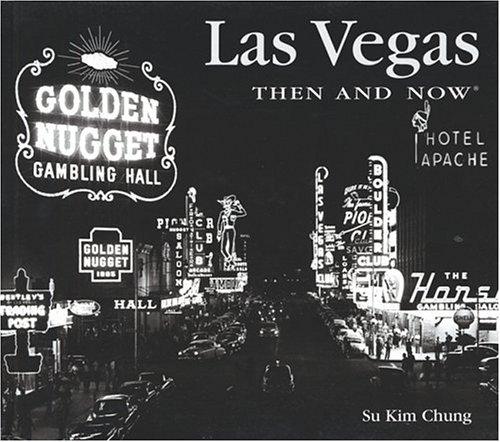
Las Vegas Then and Now
Features UNLV Special Collections photographs pairing the 1905 tent townsite and 1931 Fremont Street storefronts against modern Downtown.
View Hardcover on Amazon ↗
Suburban Xanadu: The Casino Resort on the Las Vegas Strip and Beyond
Explains why county tax boundaries pushed Frank Detra, Guy McAfee, and Thomas Hull out of Downtown onto unincorporated Highway 91.
View Hardcover on Amazon ↗
The Green Felt Jungle
Documents how ex-Los Angeles vice operators like Guy McAfee transitioned from illegal California clubs into licensed Nevada casino ownership.
View Hardcover on Amazon ↗
1941–1960 • Highway 91 Pioneers
5 Photos

Downtown Glitter Gulch • 1905–1995
5 Photos

Vegas Vic Pioneer Club Fremont Street History: Glitter Gulch
Read Article →
Highway 91 & Strip History • 1942–2007
5 Photos

Hotel Last Frontier Las Vegas History: New Frontier & Strike
Read Article →
1945–1993 • Luxury Strip Origins
5 Photos

Flamingo Las Vegas History: Billy Wilkerson & Bugsy Siegel
Read Article →
